Close the Diagnostic Gap: The Case for Investing in Near-Point-of-Care TB Tests
23 October 2026
The Global TB Community Advisory Board (TB CAB) has a long history of advocating for the uptake of new health innovations, influencing global and national decision-making, and supporting policy translation. In March 2026, the World Health Organization (WHO) recommended a new class of tests, near-point-of-care (NPOC) molecular tests, that offer faster, decentralized, more affordable and accessible TB diagnosis. Every year, millions of people with TB are missed by existing diagnostic systems, and fewer than half of those diagnosed are tested with WHO-recommended quality molecular tests. If used to expand TB testing, NPOCs offer an opportunity to address these deadly diagnostic gaps and link more people to lifesaving treatment and care.
The first product recommended in this new class of tests, PlusLife’s MiniDock MTB, is portable, delivers results within 30 minutes, and can be operated by health workers with minimal training. At just US$2.60 per test, it puts quality molecular testing within the reach of the primary health care clinics and communities where people first seek care. This is the first major molecular TB diagnostic innovation since GeneXpert was first endorsed by the WHO in 2010. Recognizing the potential of affordable, accessible molecular testing to transform TB diagnosis, TB CAB members are driving the introduction of NPOC tests through targeted advocacy with National TB Programs (NTPs) and key decision-makers.
Advocating for NPOC tests in GC8 funding requests, July 2026
The timing of WHO’s endorsement of NPOC tests in March 2026 came at a critical time. The Global Fund’s Grant Cycle 8 (GC8), a three-year funding period running from 2026 to 2028, opened a new window for funding national health programs just as NPOCs were ready for introduction. To facilitate access, the Global Fund encouraged country-led planning, identified NPOC tests as a priority TB investment area, and incentivized early-adopter countries by offering new NPOC tests at a reduced price when purchased with domestic funds.
Members of the Global TB CAB worked over the course of 2025 and 2026 to influence the uptake of NPOC TB tests in their home countries through participation in regional workshops and targeted advocacy on GC8 proposals and beyond. As part of this effort, they have written to their Country Coordinating Mechanisms (CCMs) and NTPs, urging the inclusion of NPOC tests and ambitious testing targets in GC8 funding requests.
- 1st July 2026: Letter to the members of the Technical Working Group for Tuberculosis in Moldova, sent by Moldova Society Against Tuberculosis (SMIT)
- 6th July 2026: Letter to the chair and other members of India Country Coordinating Mechanism, sent by Access to Rights and Knowledge (ARK) Foundation
Below is a template letter that civil society organizations can adapt to engage with the CCM and other relevant stakeholders in their own countries.
Template letter: download link
Global Day of Action, September 2026
As NPOC tests were recommended by the WHO in time for countries to include it in their GC8 funding requests, many countries have made strong national commitments to scale up access to these tests. However, commitments must translate into action. Countries need costed national rollout plans with measurable annual targets to ensure these commitments lead to real progress in closing the TB diagnostic gap.
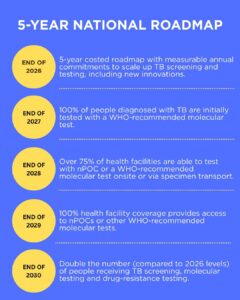
To drive this follow-through, the Global TB CAB joined a coalition of partners across the world to organize a ‘Global Day of Action’ focused on TB diagnostics. Using a shared 5-year roadmap with diagnostic targets, civil society groups organized at the national level to deliver a memorandum to their Ministries of Health (MoH) and NTPs, calling to close the deadly TB diagnostic gap. This requires ambition and national commitment, not just new technology.
Tailored to each country’s unique contexts and needs, the memorandums delivered to the MoH and NTP called for a costed, measurable five-year roadmap for scaling up WHO-recommended rapid molecular diagnostics, including the uptake of the new NPOC technologies. These memos are intended to open a dialogue with the NTP, establish community involvement in NPOC introduction, and create a mechanism for increased ambition and accountability.
TB CAB members on the Global Day of Action:
1. Kenya: 23rd September 2026: Memorandum delivered to the representatives of the Ministry of Health and the National TB Program

Ministry of Health

National TB Program
2. Moldova: 23rd September 2026: Memorandum delivered to the representatives of the Ministry of Health and the National TB Program
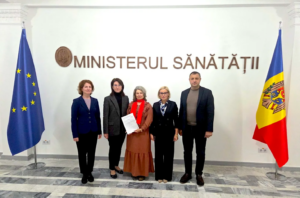
Ministry of Health
3. Uganda: 23rd September 2026: Memorandum delivered to the representatives of the Ministry of Health and the National TB Program

Below is a draft template of the letter that TB CAB members presented to their MoH and NTPs, calling for investment in diagnostics. We are sharing it as a resource for others to adapt to their own country context and use in their own advocacy.
Template letter: download link
Additionally, the TB CAB joined 167 allied organizations in signing a letter sent to regional health bodies urging them to support countries in meeting the diagnostic targets laid out in the five-year roadmap. The letter outlines key areas of action to close the diagnostics gap, including decentralized testing, strengthened sample referral systems, diverse sampling approaches and diagnostic technologies, and affordability at scale.
Here is the full letter sent to regional bodies — the Africa Centres for Disease Control and Prevention, WHO’s regional offices in the Western Pacific, Europe, Africa, South-East Asia, and the Pan American Health Organization — and can be used as a resource for future advocacy efforts.